The Ingredient List Is Not a Beauty Scorecard
Learn how to read a cosmetic ingredient list without mistaking order or unfamiliar names for quality rankings, and compare products against your own needs.
What can a cosmetic ingredient list actually tell you? A cosmetic ingredient list can help you check for substances you recognise and understand the broad shape of a formula, but it cannot rank a product as good, bad, gentle or effective on its own.
Ingredient order limits
In many markets, cosmetic ingredients are listed in descending order of concentration, with specific rules and exceptions set by the jurisdiction where the product is sold. In the United States, for example, ingredients present at one per cent or less may be listed in any order after those present at higher concentrations; colour additives also have specific ordering rules. Other markets have their own requirements, so do not assume one country’s convention applies everywhere.
The first entries can give a rough sense of a formula’s base, but the list is not a complete map. A long list does not mean a stronger formula, and an ingredient near the end is not automatically irrelevant. A small amount of a colourant, preservative or fragrance component may still have a specific function.
Read the opening names as clues about composition, not as a podium.
Names need context
Technical names can make familiar materials look suspicious. “Tocopherol” names a form of vitamin E, while “aqua” commonly means water. A recognisable botanical name, meanwhile, does not tell you how much plant-derived material is present, how it was prepared or what the finished product will feel like.
Ingredient names describe substances; they do not sort formulas neatly into good natural ingredients and bad synthetic ones. A synthetic ingredient is not automatically harsh, and a plant-derived one is not automatically suitable for everyone. Those labels alone cannot tell you how a product will behave on your skin.
If a name is unfamiliar, check a reliable ingredient glossary or the manufacturer’s product information. Treat an explanation as one clue, not a verdict on the whole formula.
What lists omit
An ingredient list does not normally explain the exact form of each ingredient, the manufacturing process, the product’s texture or how its components work together. Two products with similar-looking lists can still differ in feel and use.
The list may identify fragrance components, for example, but cannot predict how noticeable the scent will seem to you or how your skin will respond. Personal tolerance is not printed between the commas.
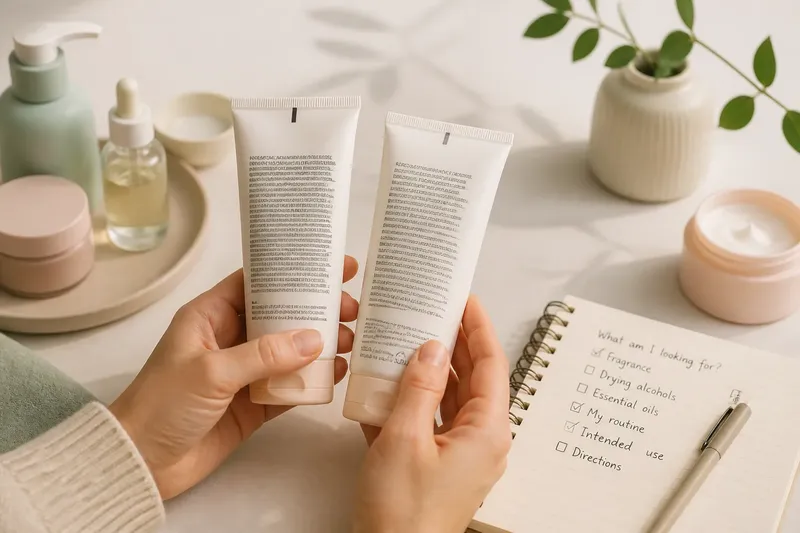
Packaging and instructions can provide further context. Intended use, storage directions and warnings may affect whether a product fits your routine.
Claims need context
Words such as “hydrating”, “brightening” or “for sensitive skin” describe claims about a finished product. They are not conclusions you can draw from one ingredient name. Seeing a familiar moisturising ingredient does not establish its concentration or what the complete product is designed to do.
Likewise, the absence of a particular ingredient does not establish that a formula is universally safer or better. One person may prefer a product that another would not choose, for reasons the list cannot explain by itself.
Compare intended use, label claims, directions and ingredients you already know you avoid. For a persistent or serious skin concern, ask a qualified clinician rather than asking an ingredient list to diagnose it.
Compare ingredient lists?
Does the first ingredient matter most?
It often indicates the largest part of the formula, but that does not make it the ingredient that matters most to your decision. A smaller amount may still be relevant to texture, preservation, colour or a personal avoidance.
Is a shorter list better?
Not by itself. A short list may be easier to review, but length does not establish quality, suitability or performance. Check the product’s purpose and the ingredients relevant to your needs.
Can I judge safety from the list?
The list can help you notice ingredients you personally avoid, but it cannot predict every individual response or assess all circumstances of use. Follow the packaging and seek qualified medical advice about a serious reaction or ongoing concern.
Why do similar products feel different?
The list does not show every formulation choice or manufacturing detail that shapes texture and application. Packaging, directions and personal preferences add information a name-by-name comparison cannot supply.
A fragrance comparison
Say you are choosing between two moisturisers and want to avoid fragrance. You begin with two products labelled as moisturisers, read each full ingredient list, and mark any fragrance terms you recognise. Then you check the directions and packaging: if one product names an ingredient you avoid, you set it aside; if neither list answers your concern, you check the manufacturer’s product information or choose another option whose labelling is clearer.
The result is a decision based on your stated preference, not a claim that one formula is objectively superior. The lists cannot tell you which texture you will enjoy or how your skin will respond.
- Check the full ingredient list: if the packaging provides it, use the complete list rather than a front-label highlight; if it is missing or unreadable, look for the manufacturer’s product information before comparing.
- Name the question: if you are checking for a known avoidance, scan for that ingredient or relevant terms; if your concern is vague, decide whether you mean fragrance, texture, intended use or something else before drawing conclusions.
- Read the directions: if the product’s stated use matches your routine, consider it on that basis; if the directions do not fit, set it aside regardless of a prominent ingredient.
- Compare like with like: if both products serve the same purpose, compare their labels and instructions; if one is a cleanser and the other a leave-on cream, do not treat their lists as direct rivals.
- Check the market context: if you are relying on an ingredient-order convention, confirm the rules for the country where the product is sold; if you cannot confirm them, treat order as a rough clue only.
- Separate label facts from guesses: if the packaging directly states a feature, record it as a label claim; if you are inferring quality or suitability from list length or a familiar name, leave that conclusion open.
Use the list well
Ingredient literacy is less about spotting a villain than asking a precise question. If you want to know whether a product lists something you avoid, the label may help; if you want to know whether it will feel pleasant, suit your skin or deliver a particular result, you need more information.
Keep a cosmetic ingredient list as one piece of evidence in a small decision, not a beauty scorecard. For ingredient-list comparisons, the useful result is a clearer choice about what the label confirms—and a clear view of what it cannot answer.