The Compact Mirror’s Journey from Tool to Keepsake
Explore the compact mirror’s changing form, from pocket-sized grooming tool to personal keepsake, and learn what its materials and design can reveal.
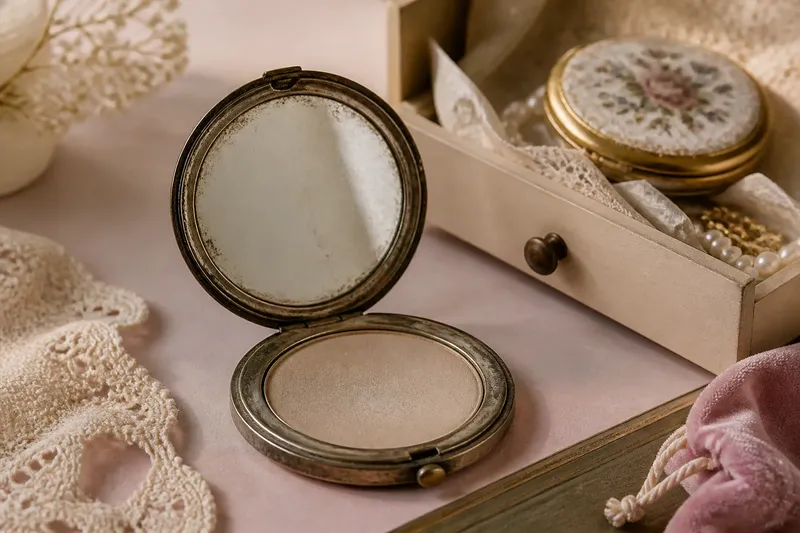
Why does a small mirror that once helped with a quick powder check end up wrapped in tissue in a jewellery drawer? The compact mirror’s journey from practical beauty tool to keepsake is written into its changing shape, materials and the meanings people attach to portable objects.
To follow that journey, begin with the object itself: how it opens, what it carries and how it is decorated. These details explain more than a broad label such as “vintage”. They show how a compact was made to be used, displayed, carried or remembered.
Start with its purpose
A compact mirror joins a reflective surface to a case that can travel. Its basic appeal is plain: it gives its owner a private view without requiring a fixed mirror. The case protects the glass and, in designs that hold powder or another cosmetic, keeps the contents close to hand.
That combination made the compact a beauty tool and a personal accessory at once. A plain case could serve an everyday routine, while an ornamented one could make the act of checking one’s appearance feel more deliberate. Neither function cancels the other; the same object may be useful at a dressing table and quietly decorative in a bag.
Notice what the design appears to prioritise. A flat, slim case is easy to slip into a pocket or small handbag; a hinged case with a powder well is organised around grooming; a highly embellished lid invites a longer look. Form is not a precise record of its owner’s habits, but it offers clues about the object’s intended life.
Read the changing form
Portable mirrors existed in forms long before the familiar hinged compact became a recognisable beauty accessory. Small hand mirrors and cases holding reflective material answered the same practical need: a view that could be carried. Over time, compact designs brought mirror, casing and sometimes cosmetic storage into a single object.
The hinged format is especially legible. Open it and the mirror becomes immediately available; close it and the reflective surface is protected. Some designs hold a second mirror, a powder compartment or an applicator. Others reduce the contents to a mirror and a case, giving decoration more room to speak.
Materials shape the experience as much as the mechanism. Metal can feel cool and substantial; enamel or lacquer gives a lid a smooth field for colour or pattern; plastic can make a case lighter and allow a broad range of finishes. Glass, hinges and clasps also affect how the object feels in the hand. A compact is a small mechanical arrangement, not merely a decorated lid.
Imagine you inherit a slim, round compact with a scratched metal case and a clasp that still closes. You might first note the hinge, mirror and interior before deciding whether to carry it or keep it on display. That pause separates what the object can still do from what it means to you.
Look at the decoration
Decoration can turn a functional case into a keepsake, but the two roles do not begin at separate dates. Engraving, applied motifs, coloured finishes and polished surfaces could make a compact feel personal while it remained a working object. A lid might carry a monogram, a floral design, a geometric pattern or a souvenir motif, each suggesting a different relationship between owner and object.
Some designs borrow the visual language of jewellery, with bright surfaces, inset details or carefully shaped edges. Others are deliberately restrained, relying on material and proportion rather than ornament. The point is not to rank one style above another; it is to see how decoration changes the object’s presence when it is opened, carried or left on a table.
Association matters too. A compact may recall a relative’s dressing table, a particular bag, a gift or a period in its owner’s life. Those memories cannot be read reliably from the pattern alone. The same motif that looks purely decorative to one person may carry a private story for another.
What can its details tell you?
Why did compacts become portable?
A small mirror offered a way to check one’s appearance away from a fixed dressing mirror. A protective case made the reflective surface easier to carry, while some designs also held powder or a small applicator.
What makes a compact a keepsake?
Decoration, an inscription, a gift connection or a remembered owner can make a compact feel worth keeping beyond its original use. Its value as a keepsake comes from that relationship, not from ornament alone.
How can you recognise how it was meant to be used?
Look for a mirror, a powder well, an applicator and a working hinge or clasp. Their presence suggests practical use, while a very shallow interior or elaborate lid may place more emphasis on carrying or display.
Can an old compact still be used?
That depends on its condition and what remains inside. A loose mirror, damaged hinge, unknown cosmetic residue or fragile finish is a good reason to keep it as a display object rather than put it into a beauty routine.
Choose use or display
If you are deciding what to do with a compact, begin with a gentle visual inspection rather than trying to polish away every sign of age. Look at the glass for cracks, the hinge for looseness, the clasp for a secure closure and the case for flaking or corrosion. Do not force a stiff hinge or scrape at an old finish; either could change the object more than intended.
For a compact you plan to carry, consider whether it closes reliably and whether the mirror gives a clear view. If it contains an old cosmetic, keep that separate from current products unless its contents are clearly identified and suitable for use. For an object with sentimental or collection value, a display shelf or padded storage may be kinder than daily handling.
Cleaning should suit the materials. A soft, dry cloth may be enough for loose dust on a sound surface. For a valuable, delicate or unidentified finish, ask a qualified conservator or antiques professional before using liquid cleaners, polish or abrasive cloths. A shine is not an improvement if it removes the surface that gives the compact its character.
Keep its story visible
A compact’s story is often most vivid in the small details: the faint mark left by repeated opening, the worn edge where a thumb rested, the way a lid catches light. Those traces connect its practical life to its later role as a keepsake. They also explain why a modest mirror can feel more personal than a larger, more elaborate object.
If you keep one, note what you know about its owner, source or use and store that information with it. The compact mirror’s journey from tool to keepsake does not require a grand provenance; sometimes the useful fact is simply whose drawer it came from, or why it was kept. Let the object remain both things: a designed beauty tool and a small container for memory.